
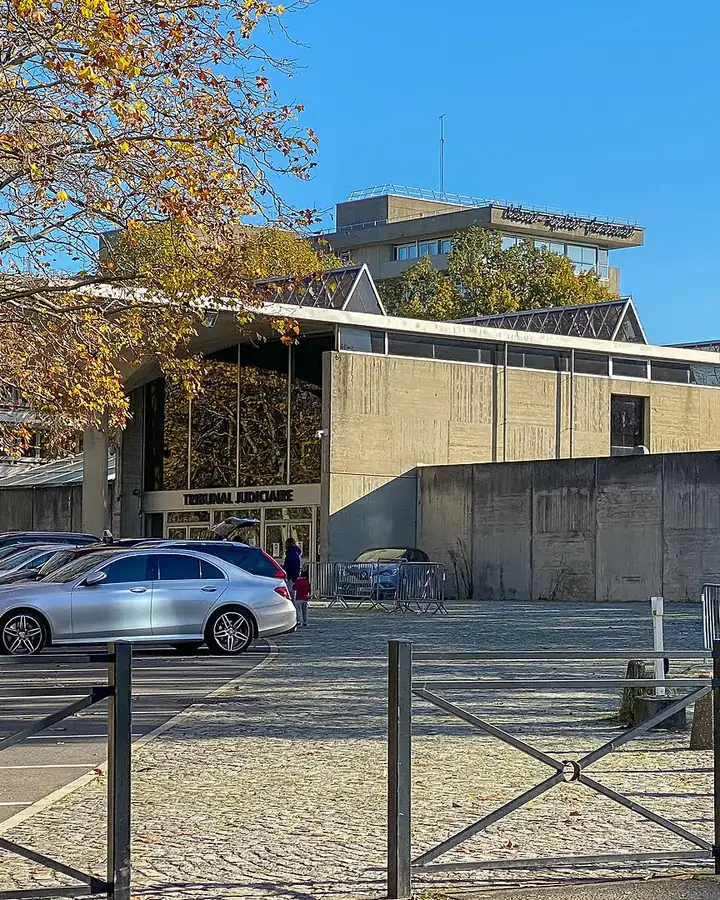
Arrested near Orly airport: Évry or Créteil?
Paris-Orly airport lies partly in the Val-de-Marne and partly in the Essonne, but the boundary between départements does not decide which court hears the case. The table of courts annexed to the Code of Judicial Organisation (tableau IV, in its version of the decree of 6 July 2026) attaches the whole airport site (emprise de l'aérodrome de Paris-Orly) to the Créteil court, through its local chamber at Ivry-sur-Seine, including the part located in the Essonne. An arrest at a terminal, a boarding gate or a customs desk at Orly is therefore dealt with in Créteil, as explained on our page on Orly airport and the Créteil court.
The towns around the airport are a different matter. The same table expressly excludes the airport site from the Longjumeau local chamber of the Évry-Courcouronnes court, but places within that chamber the neighbouring towns of Paray-Vieille-Poste, Athis-Mons, Morangis, Wissous and Chilly-Mazarin, where many airport hotels are located. A traveller arrested in a hotel in Paray-Vieille-Poste, outside the airport site, will therefore usually be prosecuted by the Évry public prosecutor (parquet d'Évry).
Under article 382 of the Code of Criminal Procedure, the criminal court with jurisdiction over an offence is that of the place where the offence was committed, of the defendant's residence, or of the place where the defendant was arrested or detained. A case can therefore sometimes be sent to another court, such as that of the defendant's home town.
Someone held in custody? Call now, day or night
+33 1 87 66 00 48What area does the Évry court cover?
Évry-Courcouronnes is the only judicial court of the Essonne (91), and it belongs to the Paris Court of Appeal (cour d'appel de Paris), like the courts of Paris, Bobigny, Créteil and Meaux. The court itself covers Évry-Courcouronnes, Corbeil-Essonnes, Ris-Orangis and Mennecy. Four local chambers cover the rest of the département: Longjumeau (Massy, Sainte-Geneviève-des-Bois, Brétigny-sur-Orge and the towns around Orly), Palaiseau (Orsay, Gif-sur-Yvette, Saclay, Les Ulis), Juvisy-sur-Orge (Viry-Châtillon, Grigny, Draveil, Yerres and Fleury-Mérogis) and Étampes (Dourdan and the south).
The court sits at 9 rue des Mazières, 91000 Évry-Courcouronnes, a few minutes' walk from Évry-Courcouronnes station on RER line D, which runs from Gare de Lyon and Châtelet. By car, it is reached from Paris by the A6 motorway. Visitors should bring an identity document and arrive early.
Police custody in the Essonne: how long, and from when?
Custody (garde à vue) takes place either in a police station (commissariat), in towns such as Évry, Massy, Juvisy-sur-Orge or Les Ulis, or in a gendarmerie unit (brigade de gendarmerie) in the rural south. The same articles of the Code of Criminal Procedure apply in both, under the supervision of the Évry prosecutor.
Custody may not exceed 24 hours. It may be extended once, by up to a further 24 hours, on the prosecutor's written and reasoned authorisation, where the offence is a crime or a délit punishable by at least one year of imprisonment (art. 63 of the Code of Criminal Procedure). Longer periods apply only to specific serious offences listed by law, such as organised crime and terrorism.
The clock does not start when the person reaches the police station. Where the person was first arrested or otherwise held for the same facts, custody runs from the time they were deprived of their liberty; where custody follows directly on from a voluntary interview, it runs from the start of that interview (art. 63). A student questioned on campus in the evening and then driven to the nearest police station, for instance, is in custody from the first moment for the purpose of the time limits. The general rules are explained on our page on the police custody lawyer in Paris.
A hearing is coming up? The firm answers 24/7
+33 1 87 66 00 48What rights does a foreign national have in custody in the Essonne?
From the start of custody, the person must be told immediately, in a language they understand, of the measure, its length and the offence suspected, and of their rights; if they do not understand French, the rights are notified through an interpreter (art. 63-1 of the Code of Criminal Procedure). They also receive a written statement of their rights in a language they understand (art. 803-6). In practice, the main rights are:
- an interpreter until the end of the proceedings, including for discussions with the lawyer linked to questioning or a hearing (preliminary article of the Code of Criminal Procedure);
- informing a relative, the employer and the consulate: the person may have someone they live with, a close relative or any other person they choose informed by telephone, as well as their employer and, for a foreign national, the consular authorities of their country. The police must act within three hours of the request, save in insurmountable circumstances. The prosecutor may defer the notice in limited cases, but beyond 48 hours of custody no longer for the consulate (art. 63-2);
- a doctor, who must examine the person within three hours of the request, save in insurmountable circumstances; a family member may also ask for this examination (art. 63-3);
- the right to remain silent: once they have given their identity, the person may make statements, answer the questions put to them, or say nothing (art. 63-1).
For an international student, a residence permit may be at stake, and parents abroad may not know where their child is. The choice of who is informed, including the consulate, belongs to the person held and is worth making early.
Can a relative abroad appoint a lawyer for someone held in the Essonne?
Yes. The person held can ask for a lawyer at any time from the start of custody, and the relative who has been informed at their request can appoint one for them. The person held must then confirm that choice (art. 63-3-1 of the Code of Criminal Procedure). If the chosen lawyer cannot be reached, or states that they cannot attend within two hours of being notified, the judicial police officer asks the president of the local Bar (bâtonnier) to appoint a duty lawyer.
Once there, the lawyer has a confidential interview of up to thirty minutes with the person held, which can be renewed at the start of any extension (art. 63-4). Where the person has asked for the lawyer to attend their interviews, they cannot be questioned about the facts without the lawyer unless they expressly waive this in the record. Any deferral of the lawyer's presence is exceptional and requires a written, reasoned decision (art. 63-4-2). After each interview or confrontation, the lawyer may ask questions and submit written observations, which are added to the case file (art. 63-4-3).
When a call comes in for someone held in the Essonne, the firm first establishes which police station or gendarmerie unit is in charge and at what time the person was deprived of liberty, then contacts the officer in charge of the case. Massy and Juvisy are close to Paris, while a gendarmerie unit near Étampes is much further out, which is why the call to the officer comes first; from Paris 7e, Évry is reached by the A6 or RER D, and Palaiseau and Orsay by RER B. A relative abroad is kept informed by telephone or e-mail, in English, within the limits of professional secrecy. Our guide for families explains what to do when a family member is arrested in Paris.
After custody: referral to the Évry prosecutor and immediate appearance
At the end of custody, the person may be released, summoned to appear later, or brought before the Évry prosecutor at the court (déferrement). A person referred in this way must appear before the magistrate the same day (art. 803-2). Where necessary, they may be held in specially equipped premises of the court and brought before the magistrate the following day, but no later than twenty hours after custody ended, failing which they must be released immediately; during that wait, they may speak with their lawyer at any time, and the lawyer may ask to read the file (art. 803-3).
Where the maximum sentence is at least two years' imprisonment, or at least six months for an offence discovered in the act, and the prosecutor considers the evidence sufficient and the case ready to be tried, the person may be brought before the Évry criminal court the same day under the immediate appearance (comparution immédiate) procedure (art. 395 of the Code of Criminal Procedure).
- The defendant can only be tried that day with their consent, given in the presence of their lawyer (art. 397).
- If they refuse, or if the case is not ready, the court adjourns to a hearing held no earlier than four weeks, unless the defendant expressly waives this, and no later than ten weeks afterwards (art. 397-1).
- If the defendant is held in pre-trial detention pending an adjourned hearing, judgment on the merits must be delivered within three months of their first appearance before the court, failing which the detention ends (art. 397-3).
For someone who lives abroad, choosing between being tried at once and an adjournment is rarely simple, since the court then decides whether the defendant remains free, under judicial supervision (contrôle judiciaire) or detained until the new hearing (art. 397-3). Before the hearing, the lawyer reads the file at the court, meets the defendant with an interpreter where needed, and explains these options (see our page on immediate appearance). The lawyer then argues on guilt, sentence and detention. Each case is prepared individually, in accordance with the professional rules of the Bar, and no outcome can be guaranteed.
A relative detained at Fleury-Mérogis: which judge decides on release?
Fleury-Mérogis, home to one of the largest prisons in the Paris region, lies within the area of the Évry court, through its Juvisy-sur-Orge local chamber (tableau IV of the Code of Judicial Organisation), with a consequence families often overlook. Once a sentence is being served, the sentence enforcement judge (juge de l'application des peines) with territorial jurisdiction is, as a rule, the one of the court in whose area the prison where the person is held is located (art. 712-10 of the Code of Criminal Procedure).
A person tried in Paris, Bobigny or Créteil and then held at Fleury-Mérogis will therefore usually have their applications for day release, electronic monitoring or parole examined by the sentence enforcement judge in Évry, not by a judge of the court that convicted them. The supporting documents (accommodation, an offer of employment or training) must therefore be prepared for the Évry judge, and the firm assists with this file and at the hearing.
Where are appeals from the Évry criminal court heard?
Judgments of the criminal court can be challenged on appeal, and the appeal goes to the court of appeal (art. 496 of the Code of Criminal Procedure). For Évry, that is the Paris Court of Appeal, on the Île de la Cité, not the Versailles Court of Appeal, even though the Essonne borders the Yvelines. See our pages on the Paris Judicial Court and the Meaux court, in the same jurisdiction.
The time limit is short: ten days from the delivery of a judgment given after an adversarial hearing (art. 498). In some cases where the defendant was neither present nor represented when the judgment was delivered, time runs only from service of the judgment. For someone who has flown home, the decision to appeal should be discussed with the lawyer as soon as the judgment is delivered.
Criminal emergency 24/7
Police custody or a court hearing in Paris? The firm intervenes without delay.